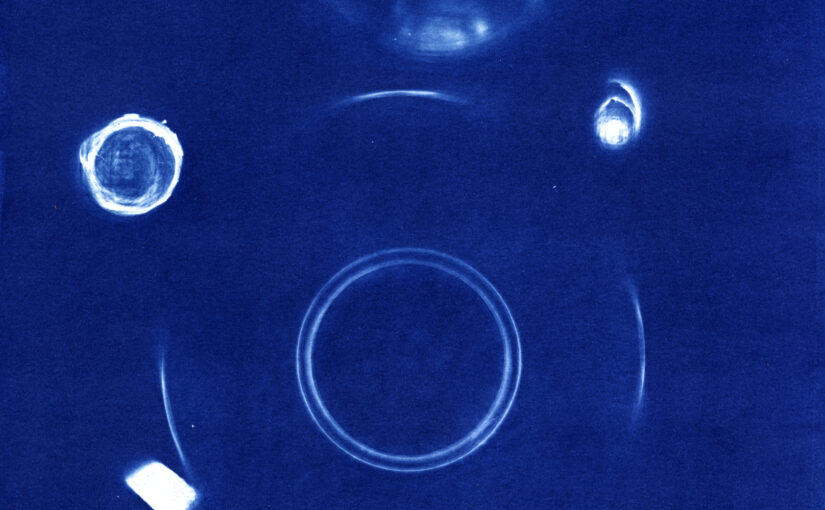
Back to the basics of cyanotype. Just put some random objects on the paper and let the light do the work. This one is poorly composed, and the main interest for me is to see how glass or other materials are working. We got glass, wood chips, and glass with water + floating wood chips.
The other day, I published a picture on Instagram, and was thinking I would like to have something like that printed with Cyanotype (this is the last one here). So there I went to download the picture from my phone and make a digital negative out of it. And then while I was browsing the pics in my Instagram folder, I just can’t help it but picking up a bunch to make some prints. And I guess I’m gonna use this material. I’m clearly not a big fan of digital photography, I just don’t enjoy using a photo editing software. I have tons of pictures on HDD that are not sorted and not processed, just because I don’t feel like doing that. Instead I prefer going to the dark room and craft some pictures. So Insta for me is a good bargain, I get some processed pictures in a minute. And then I can use this raw material to go further in the process.
Here we go again with some cyanotype experiments. Today, we are comparing side by side the same image with EDN curves and without it. The methodology is what it is. Not perfect :
same paper coated during the same batch
same exposure time (let’s say +- 1 sec) with the same exposure unit
The two negatives only differ by applying a curve that was generated with the EDN method. One drawback is that the paper was not from the same coating batch when I prepared for the EDN thing. Though it is the same paper and same batch of chemistry.
Now lets look at the results :
On the left, without the correction curves, we have stronger contrast and deep dark blue.
on the right, with the correction curves applied to the negative, we have a more balanced image and we are getting more details in the shadows.
So the conclusion, is obviously that there’s a difference. I used an already contrasted image on purpose, and to me the curve do not bring much in that case. But if we got a landscape with lots of details I’ll use these curves to make sure I’m not losing those details in the shadows (for instance in the trees).
This is what I really enjoy as a vacations : hiking in the mountains and taking pictures. This is in the south of the French Alps in a region called Champsaur. For the little story, this is the place Vivian Maier comes from. There’s a little Museum in one of the small Villages. This is not a place with high peaks covered with eternal snow, but you can get up to 3100m. That’s enough to get a very nice view on the other well known peaks like “Meije”, “Rateau” or “Barre des Ecrins”. But back to this picture, here we are not so high in the mountain, this is near the start of one of the hike we usually do in the Valley of Roanne, and that takes us to the top of “Petite Autane”. That day I was carrying my Fuji GW690 camera. And I have to say, I enjoy a lot using this camera. The patch of the rangefinder is just bright and sharp. And talking about sharp, I think these are the first scans I’m doing from negatives produced with this camera, and hell they are sharp too. So I decided to give it a shot with an enlarged digital negative and print it with cyanotype. Then toned in coffee. And here we go with an image that I like. Nothing special about it, but the level of details and the tonal range please me enough to enjoy it. Hope you’ll enjoy it too.
After several posts about toning, let’s get back to the roots and to the blue of cyanotype. I’ll probably try a toned version of this one, but I think it works just fine with the prussian blue. This was taken in Jardin des Tuilerie during one of these photo binje day (means going to several exhibitions, and take pictures in between) that I especially appreciate.
So here if you’ve red previous post, we’ve seen a very soft image due to an excess of bleach. Now here is the version which is the same exposure time for the same negative. Ok this is not the same batch of paper, this one was coated the night before. Well we’re not in the industry here with fully reproducible process. So this time it was dipped into the bleaching solution for just two or three seconds. Actually I put it face downward and let it float o the bleach solution for a few seconds and then right away in the water, and then add more water. Finally it stayed about 30 to 40 minutes in the coffee. And we still have a lots of details. Hope you enjoy it.
Here is a very soft image. Very little contrast due to a struggle with bleaching time (too long) and concentration (too strong). what is interesting here is that it almost didn’t lost any details. Toned in coffee. I’ll try to make another version with more exposure and less bleach. But overall, I’m pleased with the process, the brown from coffee are very nice, and even the taint in the white is not too much disturbing.
Subway is usually a good place to take picture. the one in Paris is over a century old and the use of an old process is to me a good fit for some of the image I can take there. But probably anything pictural is also some of interest to me at this point. What I really like here is the softness in the shadows’s transitions while keeping some overall contrast. Negative is not flipped, and fortunately there’s no readable words on the ad.
Here we go again with some toning. With Maté this time. This is the tea of the Argentinian people. They literally drink that all day long. It’s quite a bitter taste so I could imagine it has some tanins. Two years ago, we had an intern who has roots in south America, and he used to drink maté while we were having coffee. I knew this from a trip to Argentina, so I asked him if he could get a pack for me and my photographic experiments. It gives a nice brown. Here the picture was bleached first and then toned for 20 to 30 minutes.
Ok, while I was not satisfied with a specific negative, I tried to improve that. Took quite some time to remove most of the shadows and get details in the shadows. In the end it’s somehow better. Still not what I wanted it to be, but at least it’s building some xp. Here was can se a before and after. Difference in color is probably due to the fact I let the second one oxidize more before the scan. I also red on this topic that H2O2 was not necessary, and that’s right, besides the funny instant reward, there’s not much benefit about it.